The writing assistant, and typed AI decisions with a confidence gate
A model that proposes pages for a person to accept, and one that answers fixed questions and hands the uncertain ones to a person.
In the adminAssistantDecisions
The writing assistant drafts pages from a request: nothing is written until a person accepts it, and every page it touches is marked as AI-generated. Decisions are typed questions a model answers about some state, such as which queue a message goes to, each with a confidence. Below the threshold, a person decides.
Draft pages with the assistant
-
Describe what the site should have
Open Content › Assistant, write the request, and press Ask. The button names the model it will ask.
-
Read the proposal
You see each page it would add or change, and the result of every check publishing would run on the draft it would make. Pages that already exist are left alone unless you tick Replace pages that already exist.
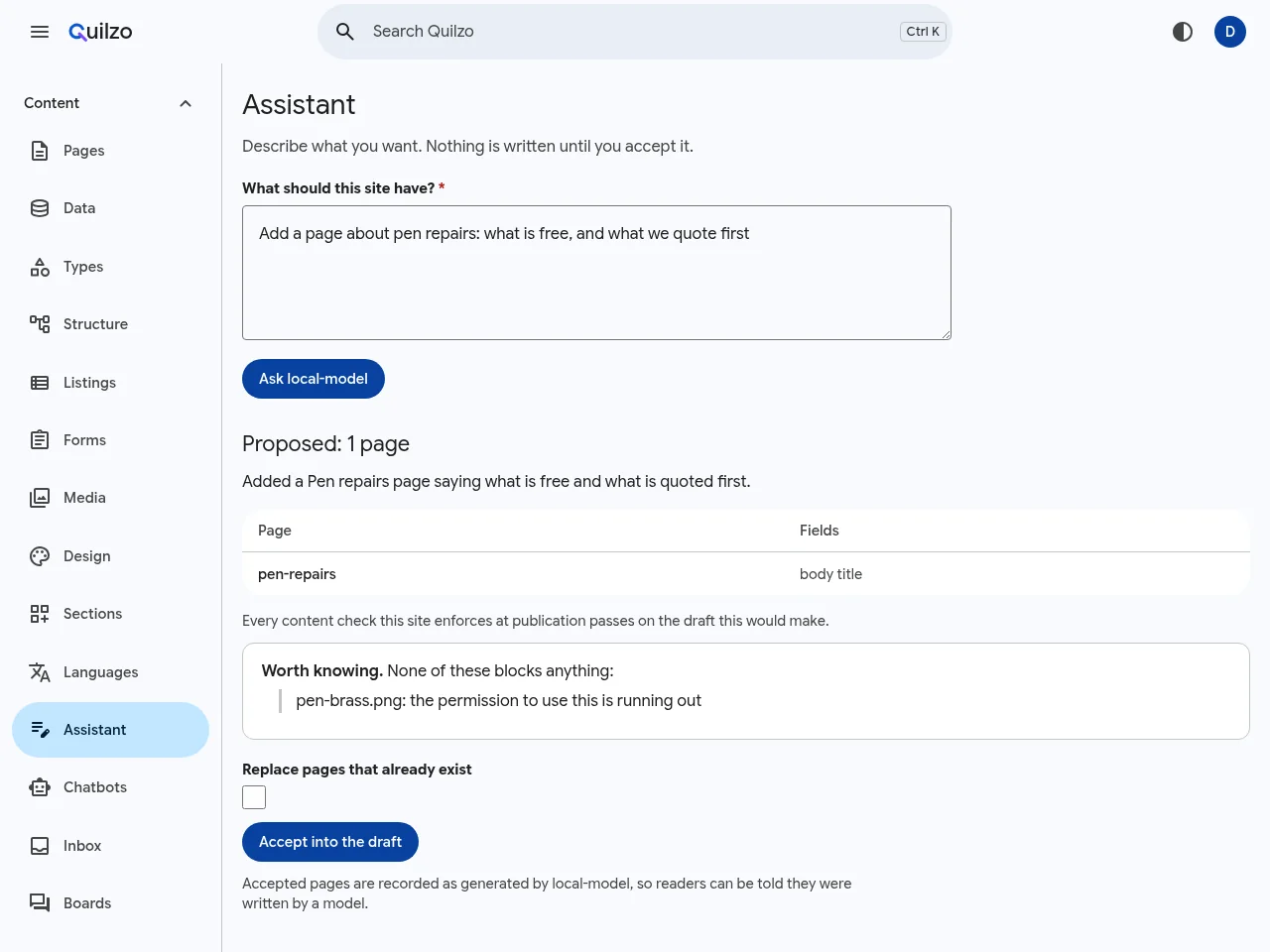
A proposed page, checked before anything is written. -
Accept it into the draft
Accept into the draft writes the pages, recorded as generated by the model. Publishing refuses pages with no provenance, and an AI-generated page is published with a machine-readable mark, as the EU AI Act's Article 50 asks. It still goes through review and publishing like any other change.
From the command line, quilzo assist writes into the draft directly; add --dry-run to see the proposal first:
quilzo assist "Add a page about gift wrapping, with the price" --author dana --dry-runasking local-model...
proposed
add gift-wrapping
Added a Gift wrapping page with the price and the handwritten note.--author names the person accountable for the change. Templates the model proposes go to --templates DIR, in Quilzo's template language, which cannot execute anything.
Typed decisions with a confidence gate
Most of what software asks a model is not "write me something". It is a bounded judgement: which queue does this ticket go to, is this comment abusive, how urgent is it. A typed decision gets one of the declared options, yes or no, or a score from 0 to 1, with a confidence, and the threshold decides what happens to an uncertain answer.
-
Declare the questions
Under Content › Decisions, paste a declaration into New decider, or save it to a file:
{
  "name": "support-triage",
  "title": "Which queue does a customer message go to?",
  "questions": [
    { "name": "queue", "ask": "Which team should answer this message?", "kind": "choice",
      "options": ["orders", "returns", "wholesale", "other"] },
    { "name": "urgent", "ask": "Does the customer need an answer today?", "kind": "yesno" }
  ],
  "min_confidence": 0.8,
  "samples": 3
}
quilzo decide set support-triage.json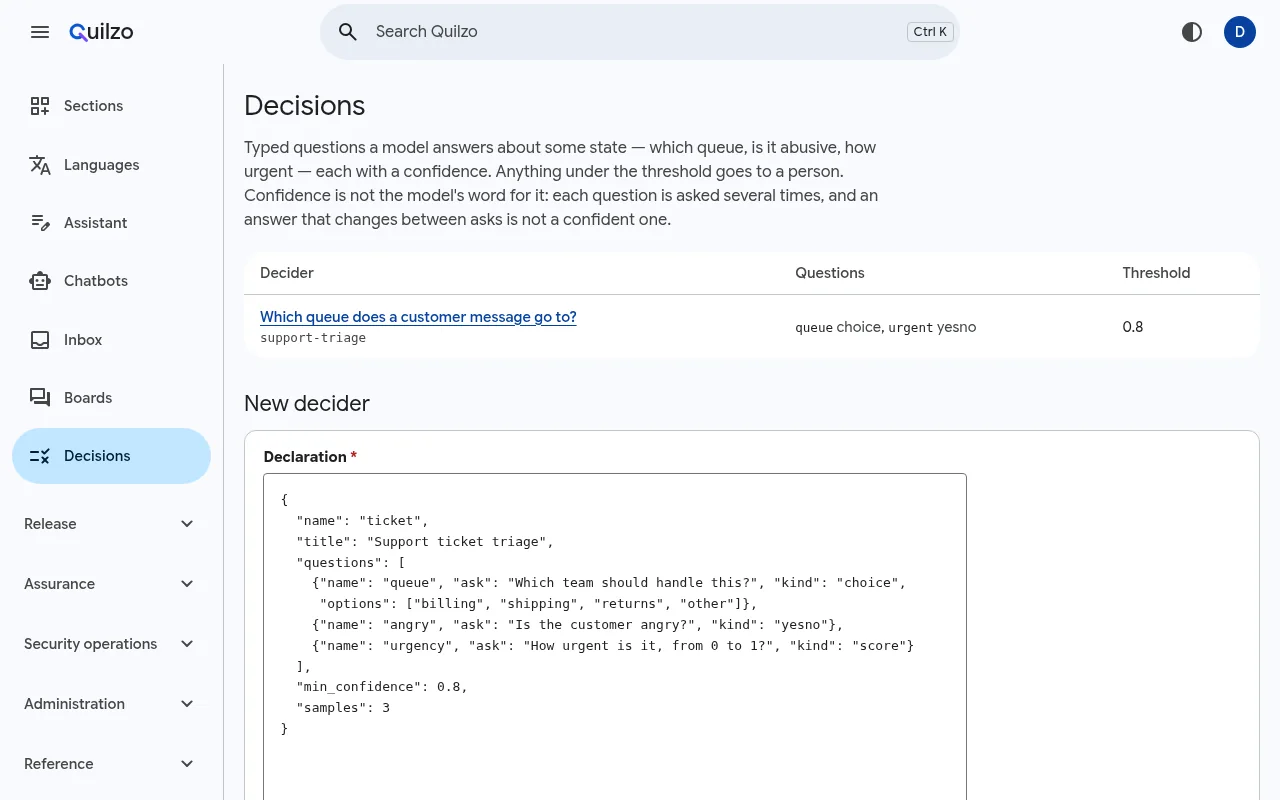
A declared decider, and the form for a new one. -
Ask it about some state
quilzo decide ask support-triage '{"message": "My ink bottle arrived cracked and leaked over the notebook."}'queue returns (confidence 0.93, agreement 1.00) urgent yes (confidence 0.88, agreement 1.00)quilzo decide ask support-triage '{"message": "Hello, quick question"}'queue a person decides — confidence 0.42 is under the 0.80 threshold urgent a person decides — confidence 0.55 is under the 0.80 threshold -
Measure it before you trust it
Run labelled cases. The report separates accuracy on what was decided automatically from how much was decided automatically, because raising the threshold trades one for the other:
quilzo decide eval support-triage cases.jsonlEach line of the cases file is a state and the answers expected:
{"state": {...}, "expect": {"queue": "returns"}}.
Why the confidence can be trusted
A model asked how confident it is gives a badly calibrated number: large models are systematically overconfident. So Quilzo asks each question samples times and measures agreement (self-consistency), and the confidence it reports is the lower of the two. A model that says 0.95 and changes its answer between samples is not 95% sure.
The state is data, fenced in the prompt as untrusted text, since a ticket is written by whoever sent it. An answer outside the declared options is refused whatever the model says. With no model configured everything escalates, which is the right failure: a decision nobody could make is one a person makes.